Sunday Links
Dow, Treasurys, Efficient Markets, Russia, Movies, Food

Dow 50,000? More like Dow 2.1 Million
Kelly Evans | 550 words | 7 Feb 2026
The Dow’s returns through the decades are a lot more impressive when you account for reinvested dividends rather than looking at just the price change.
How big a difference does this make over time? The S&P Dow folks actually have a “total return” index that lets you check, although its data is shorter-term. Still, if you started reinvesting dividends in 1987, when its tracking began, the Dow would actually be at 127,730 as of yesterday!
Researchers have gone even further back. In 2016, they estimated that if you could have reinvested dividends starting in 1926, the Dow would be closer to 672,000. I asked Gemini to update that to 2026, and because of the strong returns we’ve seen over the past decade, it reckons that level would now be 2.1 million.
The Diminished Safety of US Treasurys
Hanno Lustig | 1,500 words | 4 Feb 2026
A compelling argument that investors believe that US government debt is not the haven it once was. Lustig reminds us that RoW (the Rest of the World, meaning non-American institutions and individuals) is by far the largest holder of US Treasurys.
The correlation between stocks and bonds has turned positive since the pandemic. In the Great Financial Crisis, investors started to question the safety of privately manufactured substitutes for Treasurys. This time around, investors are questioning whether the Treasurys themselves are safe.
Is Russia Running Out of War Money?
Mathew C Klein | 3,400 words | 3 Feb 2026
“The cumulative costs of widening budget deficits and ongoing corporate borrowing may make it harder for the Russians to keep using these channels to finance further increases in military spending, especially if energy revenues continue to take a hit… While these growing constraints may not be enough to force the Russians to end their war, they will likely limit the Russians’ ability to increase their efforts from 2025 levels, which in turn were far from sufficient to help advance the Russians’ objectives.” (The Overshoot)
A Tour of Market Efficiency (and Inefficiency)
Michael Mauboussin | 97 pages | 21 Jan 2026
A historical guide to beliefs about market efficiency and the evidence that supports or dispels them. Long but worthwhile. Especially fun are the clippings from intellectuals and researchers who have contributed their particular definitions of market efficiency through the decades:
Sanford Grossman and Joseph Stiglitz wrote a paper in 1980 called “On the Impossibility of Informationally Efficient Markets.” They argue that markets cannot be perfectly efficient because there is a cost to gathering information and reflecting it in asset prices, which means there must be a proportionate benefit in the form of excess returns that investors will be motivated to capture… The Grossman-Stiglitz paradox says that if markets were perfectly efficient, investors would have no incentive to collect information, yet prices cannot be efficient without informed traders. Lasse Pedersen, a professor of finance, cleverly captures the paradox by saying markets must be “efficiently inefficient.” In this market, investors seek to “buy” information and “sell” it at a profit.
Paul Samuelson articulated what has become known as the “Samuelson Dictum”: the stock market shows “micro efficiency” and “macro inefficiency.” Micro efficiency suggests that individual stocks are accurately priced relative to one another. Macro inefficiency says that prices for the market overall can stray far from fundamental value.
Fischer Black defined “an efficient market as one in which price is within a factor of 2 of value, i.e., the price is more than half of value and less than twice value.” This is a remarkably wide band. Indeed, there is evidence that investors form expectations for returns without a strong view of what the proper price should be, what academics call “price agnostic demand.” A strict interpretation of the efficient market hypothesis (EMH) says that “at any point in time the actual price of a security will be a good estimate of its intrinsic value.” It is hard to take this idea too seriously if we accept Black’s range of gaps between price and value.
Five Tech Movies that Got It Right
Michael Luca | 1,800 words | 6 Feb 2026
“Some of the movies that have held up best — as insights about technology itself — anticipated three key features of the digital age: the abundance of information and resulting struggles over trust, truth and surveillance; the chase for convenience and immediacy, often at odds with human connection; and technology’s capacity to amplify inequality and reshape power.” I would add that all five of the movies chosen also hold up beautifully as movies. (Bloomberg Weekend)
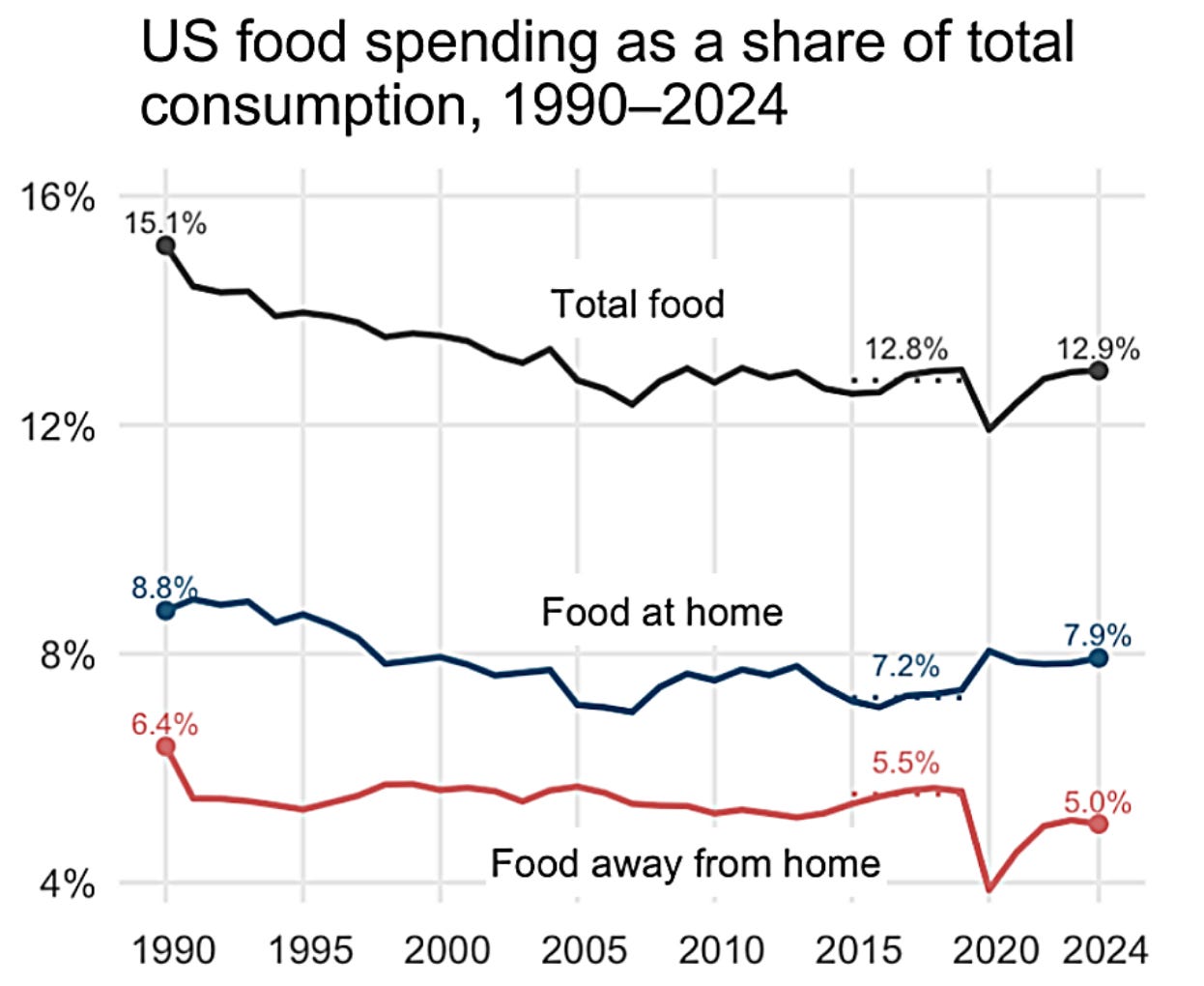
CHART: Food as a share of consumption (from Stefan Schubert, who adapted it from Mike Konczal. I strongly recommend both of their Substacks):